Modi Government Prioritizes Development, Puts an End to Corruption, Scams, and Appeasement Politics – Shatrughna Kate

A Review of the Successful 11-Year Tenure of Prime Minister Modi’s Government from ‘Atmanirbhar Bharat’ to ‘Viksit Bharat’
Pimpri Chinchwad | Over the last 11 years, the Modi government has functioned with transparency, integrity, dynamism, and decisiveness. The era of corruption, scams, and appeasement politics has been brought to an end, and development has been prioritized. The concept of “governance means service” has been effectively implemented. Transparency and accountability in governance have increased through the effective use of technology. Due to the Direct Benefit Transfer (DBT) system, benefits of schemes are directly credited to beneficiaries’ bank accounts, eliminating middlemen. The Goods and Services Tax (GST) system has streamlined taxation and curbed corruption. During this period, the abrogation of Article 370 has strengthened Jammu & Kashmir’s integration with India, which stands as a historic decision, said BJP city president Shatrughan (Bapu) Kate.
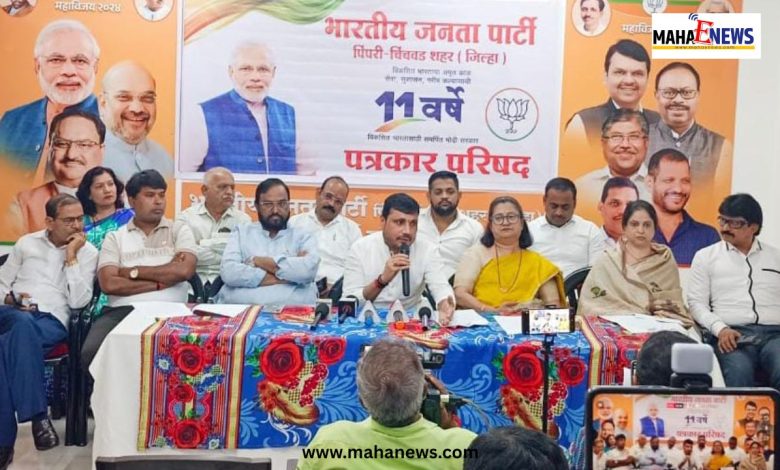
A press conference was held at the central BJP office in Morwadi, Pimpri, to mark the successful completion of 11 years of the central government led by Prime Minister Narendra Modi.
On this occasion, BJP city president Shatrughan (Bapu) Kate elaborated on various schemes, major decisions, and effective initiatives under the government’s guiding principles of “Service, Good Governance, and Welfare of the Poor.” He highlighted how India has taken a successful journey from the vision of ‘Atmanirbhar Bharat’ to ‘Viksit Bharat’ during these 11 unprecedented years of capable governance.
Present on the occasion were MLAs Amit Gorkhe and Uma Khapre, former MP Amar Sable, former MLA Ashwini Jagtap, BJYM State President Anup More, South Region President Rajesh Pille, former PCNTDA Chairman Sadashiv Khade, state members Moreshwar Shedge, Mahesh Kulkarni, Chandrakant Nakhate, Santosh Kalate, Women’s Wing President Sujata Palande, General Secretary Sanjay Mangodekar, Ajay Patade, Senior Vice President Rajabhau Durge, BJYM City President Raj Tapkir, BJP OBC Morcha State General Secretary Manoj Brahmankar, BJP Nomadic Tribes Morcha State Vice President Kailas Sanap, Social Media Head Sanjeevani Pandey, Amey Deshpande and others.
Kate further stated that the central government has significantly contributed to Maharashtra’s development. Railway projects worth ₹1.75 lakh crore are underway in the state. In just one year, the Modi government has allocated more funds to Maharashtra than the total funds given during the 10 years of the UPA government. Infrastructure projects worth ₹6 lakh crore are rapidly progressing in the state. Under the ‘Housing for All’ mission, a record 30 lakh houses have been built. Several important projects in Mumbai and across Maharashtra, pending for the last 40 years, have been initiated and are nearing completion under the Modi government.
Welfare of the poor has been central to the Modi government’s policies. Food security has been ensured by distributing free food grains to 81 crore people. Under the Jal Jeevan Mission, 15 crore people have received tap water connections. Ayushman Bharat has provided free medical treatment up to ₹5 lakh, offering health coverage to lakhs of poor families. Crores of women have received free gas connections under the Ujjwala Yojana. With 55 crore Jan Dhan accounts opened, banking services have been extended to the masses. Schemes like PM Awas Yojana, Jal Jeevan Mission, and PM-Kisan Samman Nidhi have brought significant positive change to the lives of the poor, rural population, and farmers. Under the Mudra Yojana, over 52 crore people received loans for self-employment. More than 25 crore people have been lifted above the poverty line by directly benefiting the deprived sections.
Through the UDAN scheme, 1.5 crore Indians have traveled by air, and the number of operational airports has increased from 74 to 160. The number of Vande Bharat Express trains has reached 136 and is expected to grow to 400 soon.
The agricultural budget has increased to ₹1.37 lakh crore, and ₹3.07 lakh crore has been directly transferred to farmers’ accounts. Around ₹25,000 crore has been invested in irrigation projects, enhancing irrigation facilities. Minimum Support Prices (MSP) have been consistently raised. Honey exports have tripled in the last 11 years, and the number of solar pumps has increased to 10 lakh. By establishing a separate Ministry of Cooperation, massive support has been extended to the sugar industry through NCDC, amounting to ₹55,000 crore – something unprecedented in the last 50 years.
Various schemes have been implemented to empower women and youth. A policy to reserve 33% seats for women in Parliament and state legislatures has been introduced. For the first time, a women’s battalion has been deployed on the Line of Control (LOC). About 73% of houses are now registered in women’s names. Three crore ‘Lakhpati Didis’ have been created, with Maharashtra targeting to create one crore. Around 90 lakh women’s self-help groups have been formed to make them economically empowered. Maternal mortality has significantly declined to a rate of 80. A National Education Policy has been introduced to globalize education, leading to the establishment of 8 new IIMs and 490 new universities. EPFO accounts for 3 crore youth aged 18-28 have been opened. The decision to make income up to ₹12 lakh tax-free has provided relief to salaried and middle-class citizens.
The government has worked with a “Nation First” approach. Under Operation Sindoor, 9 terrorist camps in Pakistan were destroyed, showcasing India’s valor to the world. Indigenous defense production has been encouraged – 5,000 previously imported defense items are now made in India and are being exported. Defense equipment worth ₹24,000 crore has been procured under the ‘Make in India’ initiative. With the success of Chandrayaan-3, India achieved what even Japan couldn’t. The government is swiftly moving toward the elimination of Naxalism through accelerated anti-Naxal operations.
India has made a significant leap in economic progress. In 2014, India ranked 10th in the global economy; now it is the 4th largest and is expected to become the 3rd largest in the next three years. Foreign investments have increased by 26%. Initiatives like Make in India, Startup India, and Digital India have made India self-reliant. Globally, India is now recognized and respected. Prime Minister Modi’s foreign visits and diplomatic engagements have earned India great respect at the international level.
During this period, efforts have also been made to preserve culture and identity. Cultural revival has been encouraged through projects like the construction of the Ram Mandir and the Kashi Vishwanath Corridor. Prime Minister Modi has credited this success to the 140 crore Indians. Through the mantra of “Sabka Saath, Sabka Vikas, Sabka Vishwas, Sabka Prayas,” India is taking firm steps towards becoming a developed nation, said Shatrughan Kate in the press conference.